
This study examines how natural convection flow down a vertical flat plate is affected by varying viscosity and thermal conductivity, taking into account the effects of heat conduction and viscous dissipation. The fluid flow and heat transfer are described mathematically, accounting for temperature-dependent changes in thermal conductivity and viscosity. Using suitable boundary conditions, the governing equations—such as the momentum, energy, and continuity equations—are numerically solved. The impact of these changes on temperature distributions, velocity profiles, Nusselt number, and total heat transfer efficiency is the main focus of the analysis. The findings show that changes in thermal conductivity and viscosity have a major effect on the establishment of thermal boundary layers, heat transfer efficiency, and flow characteristics. The research was conducted to improve the comprehension and prediction of heat transfer processes in a variety of engineering applications by examining the effect of varying thermal conductivity and viscosity on natural convection flow along a vertical flat plate with heat conduction and viscous dissipation. Natural convection is essential in situations where heat transmission occurs without external mechanical aid, including cooling systems, electronic gadgets, and building ventilation. Researchers seek to create more precise models for predicting fluid flow and heat transfer behaviour under varying settings by examining these changes.
| Published in | American Journal of Physics and Applications (Volume 13, Issue 6) |
| DOI | 10.11648/j.ajpa.20251306.11 |
| Page(s) | 148-161 |
| Creative Commons |
This is an Open Access article, distributed under the terms of the Creative Commons Attribution 4.0 International License (http://creativecommons.org/licenses/by/4.0/), which permits unrestricted use, distribution and reproduction in any medium or format, provided the original work is properly cited. |
| Copyright |
Copyright © The Author(s), 2025. Published by Science Publishing Group |
Steady State, Variation of Viscosity, Variation of Thermal Conductivity, Heat Generation, Viscous Dissipation, Joule Heating
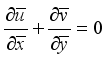 (1)
(1)  (2)
(2)  (3)
(3)  and
and  are the velocity components along with the
  and
and  axis respectively,
  is the time,
  is the temperature of the fluid in the boundary layer and
  is the fluid temperature far away from the plate, g is the acceleration due to gravity,
  is the thermal conductivity of the fluid,
  is the density,
  is the specific heat at constant pressure and
  is the variable dynamic co-efficient of viscosity of the fluid. The amount of heat generated or absorbed per unit volume is
  , Q0 being a constant, which may take either positive or negative and the hydrostatic pressure
  where,
  . The source term represents the heat formation when Q0 0 and the heat absorption when Q0 0.
  is the thermal conductivity of the fluid depending on the fluid temperature
  ,
,  is the electric conduction and
  is the magnetic field strength.
  for all
 at
at  (4)
(4)  at
at 
 as
as 
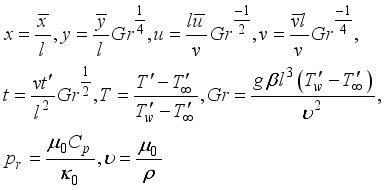 (5)
(5)  (6)
(6)  (7)
(7)  and
and  denote the viscosity and thermal conductivity variation parameters respectively, depended on the nature of the fluid. Here
  and
and  are the viscosity and the thermal conductivity at temperature
  .
. 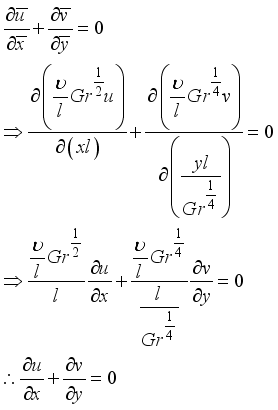 (8)
(8) 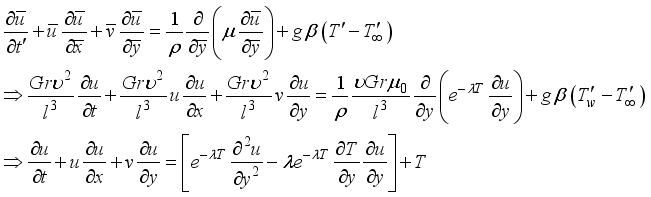 (9)
(9) 

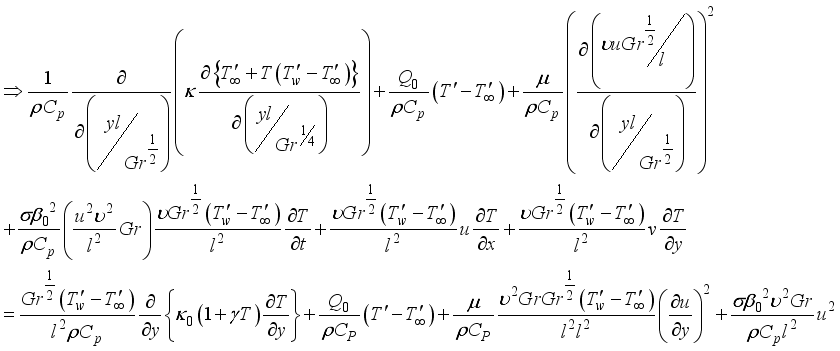
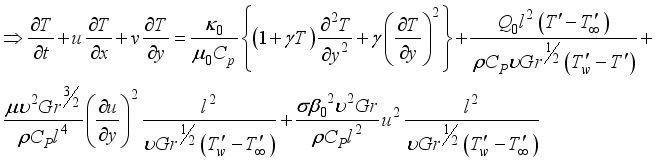





 (10)
(10)  for all
 at
at 
 at
at 
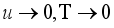 at
at  (11)
(11) 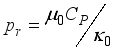 , the Prandtl’s number,
 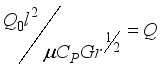 is the heat formation parameter
 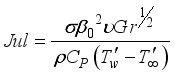 , is the joule heating parameter and
 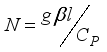 is viscous dissipation parameter.
 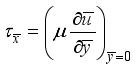 (12)
(12) 
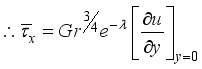 (13)
(13) 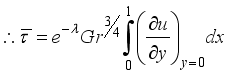 (14)
(14) 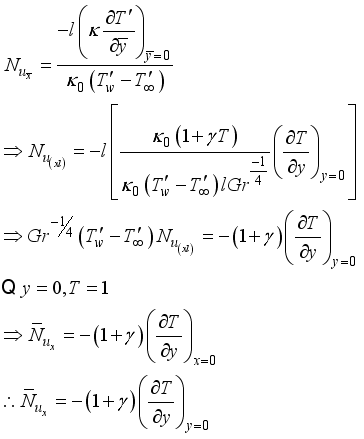
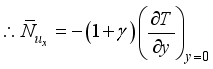 (15)
(15) 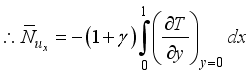 (16)
(16)  (17)
(17) 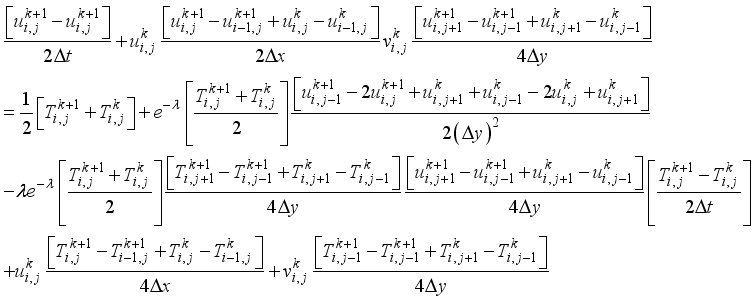 (18)
(18) 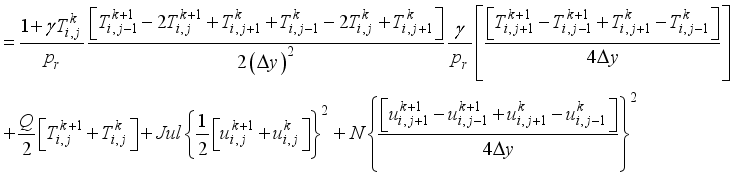 (19)
(19)  (=1) and
  (=10), where
  corresponds to y approaches to . After some initial research, the maximum of y was determined to be (6) in order to satisfy the final two boundary conditions (11). In this case, the grid point along the u-direction is indicated by the subscript i, the v-direction by j, and the t-direction by the superscript k. The coefficients
  and
and  that appear in the difference equations are treated as constants throughout any one-time step.
  = 0.05,
  = 0.25, and time step
  = 0.01 after a few sets of mesh sizes were taken into consideration. The results are compared after the spatial mesh size is reduced by 50% in one direction and subsequently in both directions. It has been noted that the results vary to the fourth decimal place when the mesh size is decreased by 50% in both the x and y directions. As a result, the sizes listed above have been deemed suitable for calculations.
  0 as <i></i>t. <i></i>x and <i></i>y
  0, which shows that the scheme is compatible. Additionally, it is demonstrated that the Crank-Nicolson type of implicit finite difference scheme is unconditionally stable for a natural convective flow, where the velocity u and v are always non-negative and non-positive, respectively. Therefore, the implicit finite difference scheme's convergence is guaranteed by compatibility and stability.
  and
and  for air (Pr = 0.733) in “Figure 2” and “Figure 3”. Our results show excellent agreement with those of G. palani, Kwang-Yong Kim, and Elbashbeshy & Ibrahim at the steady state.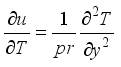
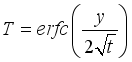 (20)
(20)  and steady state condition with Q=0.5, N=0.75, Jul=0.8,
  =0.1 and Pr= 0.73. and steady state condition with Q=0.5, N=0.75, Jul=0.8, =0.1 and Pr= 0.73.
 and steady state condition with Q=0.5, N=0.75, Jul=0.8,
  =0.1 and Pr= 0.73.
  and steady state condition with Q=0.5, N=0.75, Jul=0.8,
  =0.30 and Pr= 0.73. and steady state condition with Q=0.5, N=0.75, Jul=0.8, =0.30 and Pr= 0.73.and steady state condition with Q=0.5, N=0.75, Jul=0.8, =0.30 and Pr= 0.73.=0.10, Jul=0.8, =0.30 and Pr= 0.73.=0.10, Jul=0.8, =0.30 and Pr= 0.73.
 =0.10, Jul=0.8,
  =0.30 and Pr= 0.73.
  =0.10, Jul=0.8,
  =0.30 and Pr= 0.73. =0.10, Jul=0.8, =0.30 and Pr= 0.73.=0.10, Jul=0.8, =0.30 and Pr= 0.73.=0.10, Q=0.50, =0.30 and Pr= 0.73.=0.10, Q=0.50, =0.30 and Pr= 0.73.
 =0.10, Q=0.50,
  =0.30 and Pr= 0.73. =0.10, Q=0.5, =0.30 and Jul= 0.80.=0.10, Q=0.5, =0.30 and Jul= 0.80.
 =0.10, Q=0.5,
  =0.30 and Jul= 0.80.
  increases, the dimensionless fluid velocity increases. When the viscosity variation parameter
  is significant, a position close to the wall experiences greater velocity, which leads to a larger Nusselt number and less skin friction.
  rises, so do the fluid temperature, fluid velocity, dimensionless wall velocity gradient, and dimensionless rate of heat transfer from the plate to the fluid.
  and temperature dependent parameter
  , the local skin friction coefficient, the local Nusselt number and the velocity distribution over the whole boundary layer decreases, but the temperature distribution increase.
 Md | Mohammad |
| [1] | S. P. K. Sarkar, M. M. Alam. Effect of variable viscosity and thermal conductivity on MHD natural convection flow along a vertical flat plate. Journal of Advances in Mathematics and Computer Science. 2021, Vol. 36, No. 3, pp. 58-71. |
| [2] | M. M. Alam, M. A. Alim, M. M. K. Chowdhury. Effect of pressure stress work and viscous dissipation in natural convection flow along a vertical flat plate with heat conduction. Journal of Naval Architecture and Marine Engineering. 2006, Vol. 3, No. 2, pp. 69-76. |
| [3] | M. A. Alim, M. M. Alam, Abdullah Al-Mamun. Joule heating effect on the coupling of conduction with magneto-hydrodynamic free convection flow from a vertical flat plate. Nonlinear Analysis Modeling and Control. 2007, Vol. 12, No. 3, pp. 307-316. |
| [4] | M. M. Rahman, A. A. Mamun, M. A. Azim, M. A. Alim. Effects of temperature dependent thermal conductivity on MHD free convection flow along a vertical flat plate with heat conduction. Nonlinear Analysis Modeling and Control. 2008, Vol. 13, No. 4, pp. 513-524. |
| [5] | M. A. Alim, M. M. Alam, Abdullah Al-Mamun, Belal Hossain. The combined effect of viscous dissipation & Joule heating on the coupling of conduction & free convection along a vertical flat plate. International Communications in Heat and Mass Transfer. 2008, Vol. 35(3), pp. 338-346. |
| [6] | M. M. Molla, M. A. Hossain L. S. Yao. Natural convection flow along a vertical wavy surface temperature in presence of heat generation/absorption. Int. J. Thermal Science. 2004, Vol. 43, pp. 157-163. |
| [7] | A. K. M. Safiqul Islam, M. A. Alim, M. M. A. Sarker, A. F. M. Khodadad Khan. Effects of temperature dependent thermal conductivity on natural convection flow along a vertical flat plate with heat generation. Journal of Naval Architecture and Marine Engineering JNAME. Dec 2012. Vol. 9(2), pp. 113-122. |
| [8] | K. H. Kabir, M. A. Alim, L. S. Andallah. Effects of viscous dissipation on MHD natural convection flow along a vertical wavy surface. Journal of Theoretical and Applied Physics. a Springer Open Journal. June 2013, Vol. 7(31), pp. 1-8. |
| [9] | M. A. Hossain. Viscous and Joule heating effects on MHD free convection flow with variable plate temperature. Int. J. Heat and Mass Transfer. 1992, Vol. 35(2), pp. 3485-3487. |
| [10] | V. M. Soundalgekar, P Ganesan. Finite difference analysis of transient free convection on an isothermal flat plate. Reg. J. Energy Heat Mass Transf. 1981, 3, 219-224. |
| [11] | E. M. A. Elbashbeshy, F. N. Ibrahim. Steady free convection flow with variable viscosity and thermal diffusivity along a vertical plate. J. Phys. D Appl. Phys. 1993, 26(12), 237-2143. |
| [12] | N. G. Kafoussius, D. A. S Rees. Numerical study of the combined free and forced convective laminar boundary layer flow past a vertical isothermal flat plate with temperature dependent viscosity. Acta Mech. 1998, 127(11), 39-50. |
| [13] | M. Anwar Hossain, K. Khalil, V Kambi. The effect of radiation on free convection flow of fluid with variable viscosity from a porous vertical plate. Int. J. Therm. Sci. 2001, 40, 115-124. |
| [14] | M. A. Seddeek. Effect of variable viscosity on a MHD free convection flow past a semi-infinite flat plate with an aligned magnetic field in the case of unsteady flow. Int. J. Heat Mass Transf. 2002, 45, 931-935. |
| [15] | G. Palani, Kwang. Numerical study on vertical plate with variable viscosity and thermal conductivity. Springer-Verlag. 2009, Vol. 80, pp. 711-725. |
| [16] | J. C. Siattery, Momentum, energy and mass transfer in continua. McGraw Hill, New York. 1972. |
| [17] | H. Ockendon, J. R. Ockendon. Variable viscosity flows in heated and cooled channels. J. Fluid Mech. 1977, 83(1), 177-190. |
| [18] | E. M. A Elbashbeshy, M. F. Dimian. Effect of radiation on the flow and heat transfer over a wedge with variable viscosity. Appl. Math. Comput. 2002, 132, 445-454. |
| [19] | M. A. Seddeek, M. S. Abdelmeguid. Effects of radiation and thermal diffusivity on heat transfer over a stretching surface with variable heat flux. Phys. Lett. A. 2006; 348(3-6), 172-179. |
| [20] | K. Balamurugan, R. Karthikeyan. Viscous dissipation effect on steady free convection flow past a semi-infinite flat plate in the presence of magnetic field. International Journal of Review and Research in Applied Sciences and Engineering. 2013, Vol. 3, pp. 23-27. |
| [21] | G. Borah, G. C. Hazarika. Effects of variable viscosity & thermal conductivity on steady free convection flow along a semi-infinite vertical plate (in presence of uniform transverse magnetic field). Journal of computer & Mathematical Science. 2010, Vol. 6, pp. 732-739. |
| [22] | G. M. Abdel-Rahman. Effects of variable viscosity and thermal conductivity on unsteady MHD flow of non-Newtonian fluid over a stretching porous sheet. Thermal Science. 2013, Vol. 17, pp. 1035-1047. |
| [23] | M. M. Alam, M. A. Alim, M. M. K. Chowdhury. Free convection from a vertical permeable circular cone with pressure work and non-uniform surface temperature. Nonlinear Analysis Modelling and Control. 2007, Vol. 12, pp. 21-32. |
| [24] | S. Aktar, Mahmuda Binte Mostafa Ruma, M. A. Alim. Conjugate effects of heat and mass transfer on natural convection flow along an isothermal sphere with radiation heat loss was. Open Journal of Fluid Dynamics. 2013. Vol. 3, pp. 86-94. |
| [25] | R. Nasrin, M. A. Alim. MHD free convection flow along a vertical flat plate with thermal conductivity and viscosity depending on temperature. Journal of Naval Architecture and Marine Engineering. 2009, Vol. 6, pp. 72-83. |
| [26] | M. Miraj, M. A. Alim, M. A. H. Mamun. Effect of viscous dissipation and radiation on natural convection flow on a sphere in presence of heat generation. International Communications in Heat and Mass Transfer. 2010, Vol. 37, pp. 660–665. |
| [27] | M. R. Haque, M. M. Ali, M. M. Alam, M. A. Alim. Effect of viscous dissipation on Natural convection flow over a sphere with temperature dependent thermal conductivity. Journal of Computer and Mathematical Science. 2014, Vol. 5, pp. 5-14. |
| [28] | B. Gebhart. Effects of viscous dissipation in natural convection. Journal of Fluid Mechanics Volume 14, 1962, pp. 225-232. |
| [29] | A. Pozzi, and M. Lupo. The coupling of conduction with laminar natural convection along a flat plate. International Journal Heat Mass Transfer. 1988, 31(9), pp. 1807-1814. |
| [30] | Al-Mahasne Mayas Mohammad, Ibrahim Abu Alshaikh, Nabil Beithou, Nasser Abdellatif, Mohammad BaniKhaled, Mohd Mansour, Magdalena Joka Yildiz. Variable Temperature Plate Heat Transfer: MHD Fluid Natural Convection Flow in Porous Medium. Journal of Advanced Research in Numerical Heat Transfer. 2025, Volume 35, Issue 1 (2025) 88-100. |
| [31] | Iqbal Athal, Ioannis E. Sarris, Palani Velusamy, Vediyappan Govindan. Viscosity dissipation and mixed convection flow in a vertical double-passage channel with permeable fluid. Frontiers in Nanotechnology. 2023, Front. Nanotechnol. 4: 1058973, |
| [32] | Md. Farhad Hasan, Md. Mamun Molla, Md. Kamrujjaman, Sadia Siddiqa. Natural Convection Flow over a Vertical Permeable Circular Cone with UniformSurface Heat Flux in Temperature-Dependent Viscosity with Three-Fold Solutions within the Boundary Layer. MDPI Computation. 2022, Computation 2022, 10, 60, |
| [33] | Sujit Mishra, Aditya Kumar Pati, Ashok Misra, Saroj Kumar Mishra. Thermal performance of nanofluid flow along an isothermal vertical plate with velocity, thermal, and concentration slip boundary conditions employing buongiorno’s revised non-homogeneous model. East European Journal of Physics. 2024, Phys. 4. 98-106, |
| [34] | Uzma Ahmad, Muhammad Ashraf, A. Al-Zubaidi, Aamir Ali, Salman Saleem. Effects of temperature dependent viscosity and thermal conductivity on natural convection flow along a curved surface in the presence of exothermic catalytic chemical reaction. 2021, PLoS ONE.16(7): e0252485, |
APA Style
Al-Amin, M., Alam, M. M., Sarker, S. P. K. (2025). Impact of Varying Thermal Conductivity and Viscosity on Natural Convection Flow Along a Vertical Flat Plate with Heat Conduction and Viscous Dissipation. American Journal of Physics and Applications, 13(6), 148-161. https://doi.org/10.11648/j.ajpa.20251306.11
ACS Style
Al-Amin, M.; Alam, M. M.; Sarker, S. P. K. Impact of Varying Thermal Conductivity and Viscosity on Natural Convection Flow Along a Vertical Flat Plate with Heat Conduction and Viscous Dissipation. Am. J. Phys. Appl. 2025, 13(6), 148-161. doi: 10.11648/j.ajpa.20251306.11
AMA Style
Al-Amin M, Alam MM, Sarker SPK. Impact of Varying Thermal Conductivity and Viscosity on Natural Convection Flow Along a Vertical Flat Plate with Heat Conduction and Viscous Dissipation. Am J Phys Appl. 2025;13(6):148-161. doi: 10.11648/j.ajpa.20251306.11
@article{10.11648/j.ajpa.20251306.11,
  author = {Md. Al-Amin and Md. Mahmud Alam and Sree Pradip Kumer Sarker},
  title = {Impact of Varying Thermal Conductivity and Viscosity on Natural Convection Flow Along a Vertical Flat Plate with Heat Conduction and Viscous Dissipation},
  journal = {American Journal of Physics and Applications},
  volume = {13},
  number = {6},
  pages = {148-161},
  doi = {10.11648/j.ajpa.20251306.11},
  url = {https://doi.org/10.11648/j.ajpa.20251306.11},
  eprint = {https://article.sciencepublishinggroup.com/pdf/10.11648.j.ajpa.20251306.11},
  abstract = {This study examines how natural convection flow down a vertical flat plate is affected by varying viscosity and thermal conductivity, taking into account the effects of heat conduction and viscous dissipation. The fluid flow and heat transfer are described mathematically, accounting for temperature-dependent changes in thermal conductivity and viscosity. Using suitable boundary conditions, the governing equations—such as the momentum, energy, and continuity equations—are numerically solved. The impact of these changes on temperature distributions, velocity profiles, Nusselt number, and total heat transfer efficiency is the main focus of the analysis. The findings show that changes in thermal conductivity and viscosity have a major effect on the establishment of thermal boundary layers, heat transfer efficiency, and flow characteristics. The research was conducted to improve the comprehension and prediction of heat transfer processes in a variety of engineering applications by examining the effect of varying thermal conductivity and viscosity on natural convection flow along a vertical flat plate with heat conduction and viscous dissipation. Natural convection is essential in situations where heat transmission occurs without external mechanical aid, including cooling systems, electronic gadgets, and building ventilation. Researchers seek to create more precise models for predicting fluid flow and heat transfer behaviour under varying settings by examining these changes.},
 year = {2025}
}
TY  - JOUR
T1  - Impact of Varying Thermal Conductivity and Viscosity on Natural Convection Flow Along a Vertical Flat Plate with Heat Conduction and Viscous Dissipation
AU  - Md. Al-Amin
AU  - Md. Mahmud Alam
AU  - Sree Pradip Kumer Sarker
Y1  - 2025/12/09
PY  - 2025
N1  - https://doi.org/10.11648/j.ajpa.20251306.11
DO  - 10.11648/j.ajpa.20251306.11
T2  - American Journal of Physics and Applications
JF  - American Journal of Physics and Applications
JO  - American Journal of Physics and Applications
SP  - 148
EP  - 161
PB  - Science Publishing Group
SN  - 2330-4308
UR  - https://doi.org/10.11648/j.ajpa.20251306.11
AB  - This study examines how natural convection flow down a vertical flat plate is affected by varying viscosity and thermal conductivity, taking into account the effects of heat conduction and viscous dissipation. The fluid flow and heat transfer are described mathematically, accounting for temperature-dependent changes in thermal conductivity and viscosity. Using suitable boundary conditions, the governing equations—such as the momentum, energy, and continuity equations—are numerically solved. The impact of these changes on temperature distributions, velocity profiles, Nusselt number, and total heat transfer efficiency is the main focus of the analysis. The findings show that changes in thermal conductivity and viscosity have a major effect on the establishment of thermal boundary layers, heat transfer efficiency, and flow characteristics. The research was conducted to improve the comprehension and prediction of heat transfer processes in a variety of engineering applications by examining the effect of varying thermal conductivity and viscosity on natural convection flow along a vertical flat plate with heat conduction and viscous dissipation. Natural convection is essential in situations where heat transmission occurs without external mechanical aid, including cooling systems, electronic gadgets, and building ventilation. Researchers seek to create more precise models for predicting fluid flow and heat transfer behaviour under varying settings by examining these changes.
VL  - 13
IS  - 6
ER  -
Department of Mathematics, Dhaka University of Engineering and Technology, Gazipur, Bangladesh
Department of Mathematics, Dhaka University of Engineering and Technology, Gazipur, Bangladesh
Department of Mathematics, Dhaka University of Engineering and Technology, Gazipur, Bangladesh
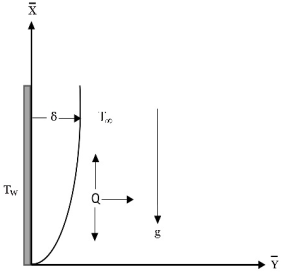
Figure 1. Geometry.
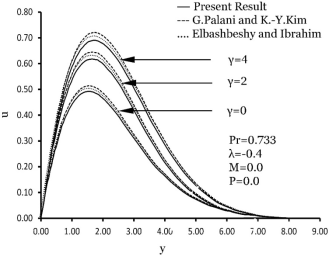
Figure 2. Comparison of Velocity profiles G. Palani and K.-Y. Kim. Elbashbeshy and Ibrahim for various values.
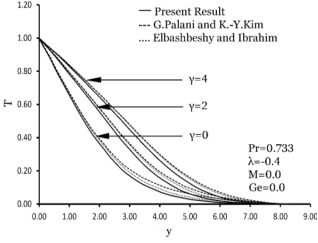
Figure 3. Comparison of Temperature profiles G. Palani and K.-Y. Kim. Elbashbeshy and Ibrahim for various values.
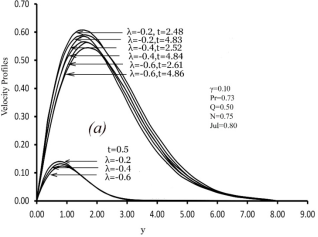
Figure 4. Variation of dimensionless Velocity profiles versus dimensionless y for various values of viscosity and steady state condition with Q=0.5, N=0.75, Jul=0.8, =0.1 and Pr= 0.73.
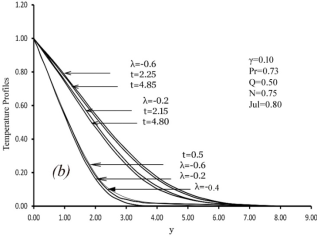
Figure 5. Variation of dimensionless Temperature profiles versus dimensionless y for various values of viscosity and steady state condition with Q=0.5, N=0.75, Jul=0.8, =0.1 and Pr= 0.73.
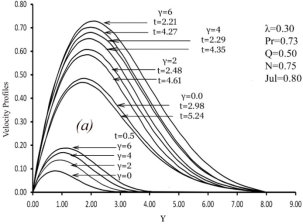
Figure 6. Variation of dimensionless Velocity profiles versus dimensionless y for various values of thermal conductivity and steady state condition with Q=0.5, N=0.75, Jul=0.8, =0.30 and Pr= 0.73.
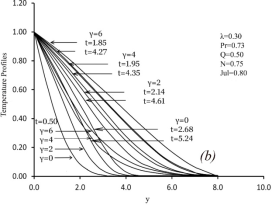
Figure 7. Variation of dimensionless velocity and temperature profiles versus dimensionless y for various values of thermal conductivity and steady state condition with Q=0.5, N=0.75, Jul=0.8, =0.30 and Pr= 0.73.
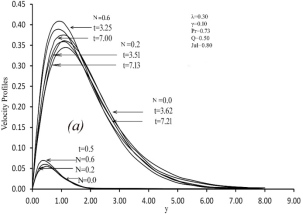
Figure 8. Variation of dimensionless velocity and temperature profiles versus dimensionless y for different values of viscous dissipation N and steady state condition with Q=0.5, =0.10, Jul=0.8, =0.30 and Pr= 0.73.
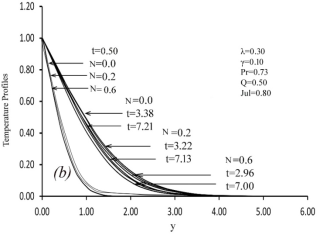
Figure 9. Variation of dimensionless velocity and temperature profiles versus dimensionless y for different values of viscous dissipation N and steady state condition with Q=0.5, =0.10, Jul=0.8, =0.30 and Pr= 0.73.
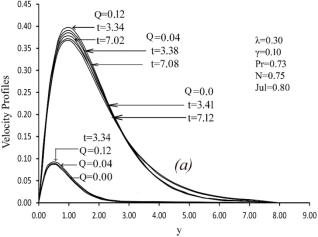
Figure 10. Variation of dimensionless Velocity profiles versus dimensionless y for different values of heat generation Q and steady state condition with N=0.75, =0.10, Jul=0.8, =0.30 and Pr= 0.73.
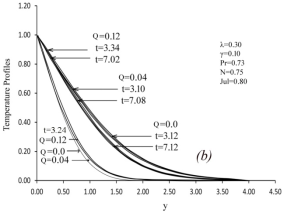
Figure 11. Variation of dimensionless velocity and temperature profiles versus dimensionless y for different values of heat generation Q and steady state condition with N=0.75, =0.10, Jul=0.8, =0.30 and Pr= 0.73.
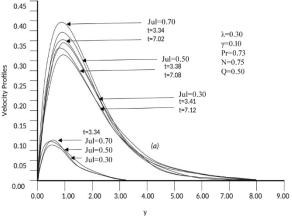
Figure 12. Variation of dimensionless Velocity profiles versus dimensionless y for different values of Joule and steady state condition with N=0.75, =0.10, Q=0.50, =0.30 and Pr= 0.73.
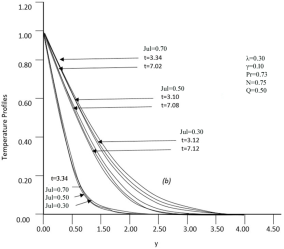
Figure 13. Variation of dimensionless Temperature profiles versus dimensionless y for different values of Joule and steady state condition with N=0.75, =0.10, Q=0.50, =0.30 and Pr= 0.73.
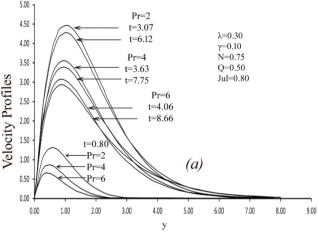
Figure 14. Variation of dimensionless Velocity profiles against dimensionless y for different values of prandtl’s number Pr and steady state condition with N=0.75, =0.10, Q=0.5, =0.30 and Jul= 0.80.
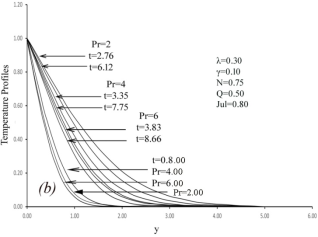
Figure 15. Variation of dimensionless Temperature profiles against dimensionless y for different values of prandtl’s number Pr and steady state condition with N=0.75, =0.10, Q=0.5, =0.30 and Jul= 0.80.
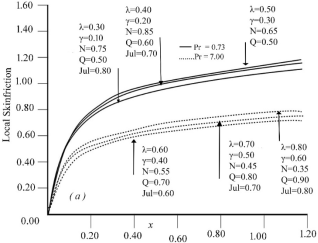
Figure 16. Variation of dimensionless Local Skin Friction versus dimensionless distance x for different values of Q, λ, γ, N, Jul and Pr at steady state condition.
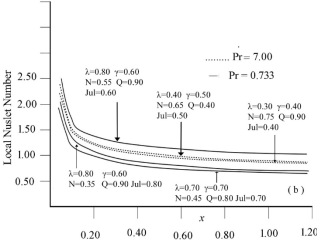
Figure 17. Variation of dimensionless Local Nusselt number versus dimensionless distance x for different values of Q, λ, γ, N, Jul and Pr at steady state condition.



 Share This Article
 Twitter
 Linked In
 Facebook
 to gives
  the average skin friction and it is given by
  to
to  gives the average skin friction and it is given by
  Copy
Copy Download